

What are the design features of a good lyophilizer?
Oct 09, 2026
Leave a message
If you’ve ever walked past a skincare shelf and spotted a serum that says “lyophilized” or bitten into a freeze-dried strawberry that bursts with intense flavor, you’ve encountered the magic of lyophilizers (aka freeze dryers) — and if you’re in the market for one, you know not all machines are created equal. As someone who’s spent years working with lyophilizer tech, I’ve seen first-hand how a well-designed unit doesn’t just dry stuff; it preserves quality, cuts down on headaches, and saves way more money in the long run. Today, I’m breaking down the key design features that make a lyophilizer actually good — and I’m dropping real examples of the gear my team and I supply along the way.
First off, let’s get the basics straight: lyophilization works by freezing a product, then lowering pressure so frozen water sublimates (turns straight from ice to vapor without melting), leaving behind a dry, shelf-stable product that retains almost all its original properties (flavor, nutrients, active ingredients — you name it). A bad lyophilizer might ruin that, leading to collapsed products, extended dry times, or even contamination. So what should you actually look for when picking one?
Let’s start with the heart of the machine: the condenser. This is the part that sucks up all the water vapor as it’s released — if it’s not powerful enough or well-designed, your lyophilizer will crawl along at a snail’s pace. Think of the condenser like a vacuum’s dust canister, but for ice: it needs to be cold enough (usually -50°C to -80°C, depending on your product) and big enough to hold all the ice your batch produces. I’ve seen small pilot units with undersized condensers that filled up mid-dry, forcing you to pause and defrost — a total waste of time and energy. For example, our line of pilot and production lyophilizers have condensers sized to match chamber volume, so you don’t get stuck mid-process. And if you’re into cosmetics, this matters big time: Application Of Freeze Dryer In Cosmetics walks through how properly sized condensers keep skincare actives (like hyaluronic acid or peptides) from degrading during the slow, delicate drying phase — no melted batches = consistent product every time.
Next up: the chamber and shelf system. The chamber is where your product sits, so its design has to be functional and flexible. For small-scale R&D, a smaller chamber is fine, but if you’re scaling to production, you need something that can handle uniform heat distribution. Uneven shelves are a huge red flag — if one spot on a shelf is 5°C hotter than another, your product will dry too fast there (leading to crusting) and too slow elsewhere (wasting cycle time). Good shelves are made of stainless steel (easy to sanitize, non-reactive), have precise temperature control (±0.5°C is the sweet spot), and are evenly thick so heat transfers uniformly. We also use shelves that cool and heat quickly — that cuts down on the ramp time between freezing and primary drying, which is a massive efficiency win. For context, our in-situ pilot units (smaller, for testing) use this exact shelf design, and one model even pairs with a Scientz-1LS The Input Power 1500 W Vacuum Centrifugal Concentrator to prep samples before they go into the lyophilizer — makes R&D workflows way smoother, trust me.
Vacuum control is another non-negotiable. Lyophilization isn’t a set-it-and-forget-it process, and bad vacuum management can mess up everything. Primary drying (when most of the ice sublimates) needs a consistent low pressure (usually 0.1 to 0.5 mbar, depending on product) — if pressure spikes too high, ice stops sublimating, and if it’s too low, you might get too rapid drying that ruins product structure. A good lyophilizer has a vacuum system that’s not just powerful, but precise. Oil-sealed pumps are common, but some modern units use oil-free pumps for easier maintenance and better performance with moisture-sensitive products. We include automated vacuum controllers that adjust in real-time, so you don’t have to babysit the machine — perfect for production runs where you’ve got a lot of other work to do.
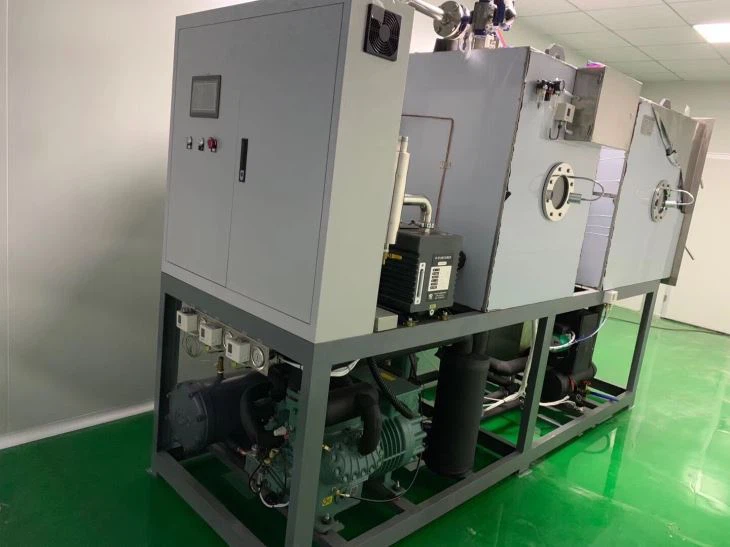

Then there’s the “smart stuff” (yes, modern lyophilizers have this now). I know some old-school folks hate bells and whistles, but built-in data logging and cycle control is a game-changer. If you’re in a regulated industry (like pharma, or even food), you need to track every step of the process for quality assurance. A solid lyophilizer will let you program custom cycles, store multiple recipes, and log all temperature, pressure, and time data — no more handwritten notes that get lost or messy. Some even have remote monitoring, so you can check on a production run from your phone or laptop if you need to adjust something last minute.
Wait, let’s talk about product-specific design, because one size definitely doesn’t fit all. If you’re drying food (like honey, berries, or veggies), the lyophilizer needs to handle products that are delicate or have high sugar content — too much heat, and they’ll caramelize. For example, a Honey Powder Vacuum Freeze Dryer Lyophilizer from our line has extra gentle temperature ramps and adjustable shelf spacing to prevent honey from sticking or clumping, which is exactly what you need if you’re making instant honey or powdered sweeteners. For soft fruits like raspberries, you need a lyophilizer with gentle shelf heating so the berry keeps its shape (no shrinkage!) and retains that bright, fruity flavor — check out our Raspberry Vacuum Freeze Dryer/Berry Freeze Drying Machine for that exact use case; I’ve seen raspberry powder made with this that tastes way better than any conventional dried version. For commercial food-scale production, our Freeze Drying N series is built to handle large batches of veggies while keeping costs per unit low — no hidden inefficiencies there.
Maintenance and usability are also big, and I can’t stress this enough. A great lyophilizer should be easy to clean (CIP-capable, or at least designed with smooth, crevice-free surfaces so gunk doesn’t build up) and have parts that are easy to replace when needed. No one wants to wait weeks for a specialty part to come in, or struggle to disassemble a chamber that’s covered in ice and crusted product. We design all our units with modular parts, so if something breaks, you don’t have to replace the whole system — saves you money and downtime. Also, the user interface shouldn’t be a confusing mess of buttons. Even if you’re not a tech genius, you should be able to pull up a saved cycle, start a run, and check status without a manual (though we provide full support, of course).
Another thing I’ve learned: don’t overlook the pre-freezing step, which is part of the lyophilizer’s overall design. Some units integrate a pre-freezing function, so you don’t have to freeze product separately before loading it into the chamber. That’s a huge convenience, especially for small batches or when you don’t have an extra freezer on hand. It also helps with uniformity, because the lyophilizer can control the freezing rate (slow vs. fast) depending on your product — fast freezing makes smaller ice crystals, which is good for things like lab samples, while slow freezing makes larger crystals, which is better for food products to keep their structure intact.
Let’s circle back to why this matters for you. Whether you’re a skincare brand wanting to make stable serums, a food company looking to launch a freeze-dried snack line, or a lab doing R&D on new materials, a bad lyophilizer will waste your time, ruin batches, and cost you more in the long run. A good one is an investment that pays off by producing consistent, high-quality product every time, cutting cycle time, and requiring minimal upkeep.
If you’re curious about any of the units I mentioned, or want to talk through what your specific needs are (like batch size, product type, budget), my team and I are here to help. We work with everyone from small startups to large production facilities, so we can match you with a lyophilizer that fits your workflow, not just a one-size-fits-all model. Reach out to start a chat about what you’re looking for — we’d love to hear from you.
References
- Application Of Freeze Dryer In Cosmetics. (n.d.). /freeze-dryer/production-freeze-dryer/application-of-freeze-dryer-in-cosmetics.html
- Scientz-1LS The Input Power 1500 W Vacuum Centrifugal Concentrator. (n.d.). /freeze-dryer/in-situ-pilot-freeze-dryer/scientz-1ls-the-input-power-1500-w-vacuum.html
- Honey Powder Vacuum Freeze Dryer Lyophilizer. (n.d.). /freeze-dryer/production-freeze-dryer/honey-powder-vacuum-freeze-dryer-lyophilizer.html
- Raspberry Vacuum Freeze Dryer/Berry Freeze Drying Machine. (n.d.). /freeze-dryer/in-situ-pilot-freeze-dryer/raspberry-vacuum-freeze-dryer/berry-free.html
- Freeze Drying N series. (n.d.). /freeze-dryer/production-freeze-dryer/commercial-food-freeze-dryer-for-vegetable.html