

What is the relationship between homogenization pressure and particle size reduction?
Nov 10, 2026
Leave a message
If you’ve ever stood next to a high-pressure homogenizer in a lab or production facility, you’ve probably felt the low rumble it emits— a sound that signals a process designed to break matter down into smaller, more consistent particles. As a homogenizer supplier, I’ve spent countless hours walking clients through how this simple machine function drives one of the most common goals in materials processing: particle size reduction. It’s a relationship that’s far more nuanced than “more pressure equals smaller particles,” and getting it right can mean the difference between a product that meets quality standards and one that fails before it even reaches customers.
Let’s start with the basics. Homogenization is the process of uniformly distributing two or more immiscible substances (like oil and water) or breaking large particles into smaller ones to create a stable, consistent mixture. Particle size reduction, the core of many homogenization tasks, relies on two primary mechanisms: shear force and cavitation. Pressure is the engine that powers both. When a sample is forced through a narrow gap in the homogenizer valve at high pressure, it accelerates to extreme speeds, creating shear forces that tear apart larger particles. At the same time, the rapid pressure drop after the gap causes liquid to vaporize, forming tiny bubbles that collapse violently (that’s cavitation)—a process that generates micro-jets and shockwaves, further breaking down particles.
The first thing my team teaches new clients is that particle size doesn’t decrease linearly with homogenization pressure. Early in my career, I worked with a pharmaceutical researcher who wanted to reduce the size of a drug nanoparticle formulation from 200 nm to 50 nm. She started at 500 bar, got results down to 80 nm, and assumed doubling the pressure to 1,000 bar would get her to 50 nm. Instead, she only got to 65 nm. That’s because once you hit a threshold pressure—usually around 700–800 bar for most aqueous samples—additional pressure doesn’t translate to proportional particle size reduction. The larger particles that are easy to break apart at lower pressure are already gone, and the remaining smaller particles are much more resistant to further breakdown. Increasing pressure beyond that point can even have negative effects: it may cause particle aggregation, or it can wear down homogenizer valve components faster, leading to inconsistent processing.
That’s not to say higher pressure never has a place. For very hard materials, like ceramics or some biological tissues, higher pressure is non-negotiable. Last quarter, we worked with a biotech firm that needed to disrupt yeast cell walls to release intracellular proteins. Their initial setup at 400 bar only released 30% of the target protein; upping the pressure to 1,200 bar boosted release to 92%. But even here, there’s a limit. Too much pressure and the cell debris becomes so small that downstream purification becomes a nightmare—filtering tiny, uniform particles is far more difficult than slightly larger, manageable ones.
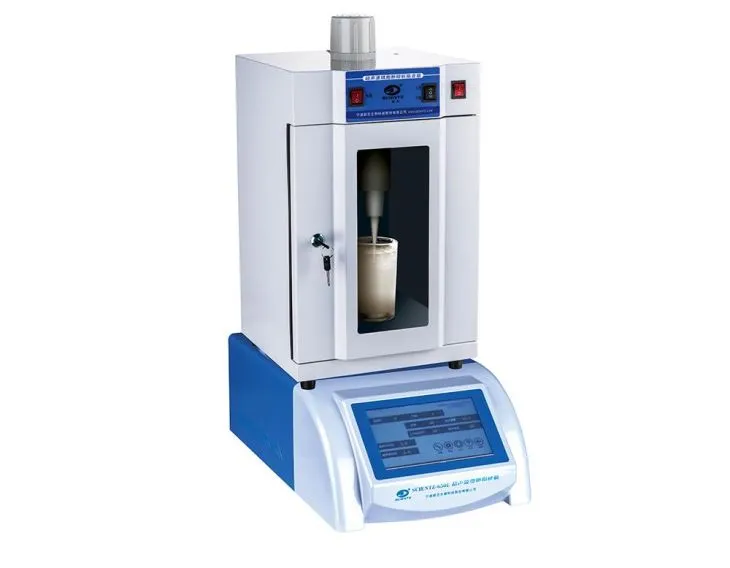
The relationship also depends on the number of homogenization passes, which is closely tied to pressure. A single pass at 1,000 bar might get you to 100 nm, but two passes at 500 bar could get you to 80 nm. That’s because each pass gives particles multiple chances to be broken down, even if the pressure per pass is lower. This is a key point for small-scale labs where equipment budgets are tight: you don’t always need the highest pressure machine to get the results you want. For example, our Integrated Probe Ultrasonicator is designed for multiple, controlled passes at lower pressure, making it ideal for lab-scale protein extraction or emulsion creation where consistency across small batches matters most. Many researchers don’t realize that ultrasonic homogenizers, which rely on cavitation instead of mechanical valve pressure, follow a similar trend but with their own pressure-dependent limits—they work best when you balance amplitude (the ultrasonic equivalent of pressure) with processing time, rather than cranking amplitude to the maximum on every sample.
Another common misconception is that particle size reduction is only about pressure. In reality, the fluid’s properties matter just as much as the machine’s pressure. Viscosity, for example, affects how easily a sample flows through the homogenizer gap. A thick slurry will experience less shear force at a given pressure than a thin solution, so you may need to increase pressure to get the same particle size reduction. Temperature also plays a role: when pressure is applied, the sample heats up, and heat can soften particles, making them easier to break. But too much heat can denature proteins or degrade sensitive materials, so homogenizer operators have to balance pressure, flow rate, and cooling to keep temperatures within safe limits. We often recommend our Micro-pretreatment Ultrasonic Homogenizer for samples that are temperature-sensitive, because its integrated cooling system lets you maintain consistent temperatures even during high-amplitude processing, so you don’t have to sacrifice particle size reduction for product integrity.
Let’s talk about industrial applications, because this relationship isn’t just for labs. In the food and beverage industry, homogenization pressure is used to keep milk from separating. Traditional milk homogenization uses two passes: the first at ~200 bar to break fat globules, and the second at ~50 bar to ensure uniformity. If a dairy plant uses too high a pressure on the second pass, the fat globules become too small, leading to a watery texture that customers reject. On the other hand, a plant making plant-based milks (which have thicker, more complex matrices) may need to increase pressure to 300–400 bar to break down the larger plant particles and create a smooth, creamy consistency. I recently spoke with a plant-based food manufacturer who switched from a 200 bar homogenizer to a 350 bar model, and they saw a 25% reduction in particle size, which cut their production time for a new oat milk product in half. That’s the practical impact of getting this right: pressure directly affects both product quality and operational efficiency.
For pharmaceutical companies, particle size reduction is critical for bioavailability. Drugs with smaller particles dissolve faster in the body, so a drug that’s only 200 nm might have 30% bioavailability, while one at 100 nm could have 80%. But as I mentioned earlier, there’s a pressure ceiling here. A client last year was working on a cancer drug formulation, and their initial pressure of 800 bar got particles down to 120 nm. They tried 1,000 bar and only got to 110 nm, which wasn’t enough to meet FDA requirements. Instead of going higher, we adjusted their process: we used three passes at 850 bar, with a small amount of surfactant added to reduce particle aggregation. That got them to 95 nm, which was exactly what they needed. This is where experience as a homogenizer supplier makes all the difference—we don’t just sell machines; we help our customers design processes that use pressure in the most effective way, not just the most extreme way.
Ultrasonic homogenizers, which are a popular alternative to high-pressure mechanical homogenizers, have their own unique pressure-particle size relationship. Instead of a valve gap, they use a vibrating probe to create cavitation. The “pressure” here is the amplitude of the probe’s vibration. For many applications, like cell lysis for Western blots or DNA extraction, a mid-range amplitude (around 20–30 microns) is enough to break cell membranes without damaging the target molecules. Our Scientz-E Series Ultrasonic Homogenizer Probe Sonicator For Cell Lysis, Tissue Disruption And Homogenization is designed with adjustable amplitude control, so researchers can dial in the exact amount of “pressure” needed—no more, no less. Cranking the amplitude too high here can cause over-heating and sample degradation, just like over-pressurizing a mechanical homogenizer. We also have a Multi-channel Probe Sonicator for high-throughput labs that need to process 96 or 384 samples at once, which uses synchronized vibration to ensure consistent particle size across every well—something that’s impossible with single-process methods.
Now, let’s address the question of how to measure this relationship. The gold standard for particle size analysis is dynamic light scattering (DLS), which gives you a size distribution curve. When you plot pressure against average particle size (usually the Z-average from DLS), you’ll see a steep curve at low pressures, a flatter curve at medium pressures, and a plateau at high pressures. That plateau is your point of diminishing returns, and it’s where you should stop increasing pressure and start adjusting other parameters—number of passes, temperature, or surfactant concentration. We always advise new clients to run a pressure gradient test: process small samples at 300, 500, 700, 900, and 1,100 bar, then measure particle size at each step. This test takes less than an hour and tells you exactly where your pressure plateau is, so you can choose the right homogenizer and process parameters without wasting time or money on unnecessary high pressure.
There are also edge cases where the pressure-particle size relationship is different. For example, when processing emulsions with very small initial droplet sizes (less than 1 micron), increasing pressure above 600 bar can actually cause droplets to merge, rather than break apart. That’s because the shear force is so high that it’s pushing the droplets together, instead of pulling them apart. We had a client making a cosmetic lotion who ran into this problem: they increased pressure to 800 bar to get smaller droplets, but instead, the lotion became lumpy. We suggested they drop the pressure to 500 bar and add a small amount of emulsifier, and they got the same droplet size without the aggregation. This is a great example of how the relationship isn’t universal—it depends on the material you’re processing, so you can’t rely on generic pressure guidelines.
As a homogenizer supplier, our job isn’t just to provide equipment—it’s to help our customers understand how pressure interacts with their specific materials to achieve their goals. Whether you’re a lab researcher working on a new drug formulation, a food manufacturer perfecting a plant-based product, or a biotech company disrupting cells for protein extraction, the key takeaway is this: particle size reduction from homogenization pressure is a non-linear relationship. You’ll get the most gain at lower to medium pressures, and once you hit the plateau, additional pressure won’t help—and may hurt—your process.
If you’re ready to test how pressure affects your particle size reduction, or if you’re looking for a homogenizer tailored to your application, our team is here to help. We can provide process development support, run sample tests on our equipment, and recommend the right model for your needs—from small-lab ultrasonic units to industrial high-pressure homogenizers. Contact our team today to discuss your specific requirements.

References
- Bolz, J., & Schmidt, G. (2020). High-Pressure Homogenization: Principles and Applications in Pharmaceutical Nanoparticle Production. Journal of Pharmaceutical Sciences, 109(3), 1129–1141.
- Gallego-Juárez, J. A., & Graff, K. F. (2015). Ultrasonic Homogenization: Principles and Applications. Elsevier.
- McClements, D. J. (2017). Food Emulsions: Principles, Practice, and Techniques (4th ed.). CRC Press.
- Patton, J. S., & Carey, M. C. (2018). Homogenization of Biological Samples: Mechanisms and Best Practices. Analytical Biochemistry, 546, 1–10.