

Does your girlfriend's cosmetics contain banned alkaloids?
May 15, 2019
Leave a message
 |
I still don't describe the difference between your girlfriend's makeup before makeup. First, learn Wen Tingjun's "Buddha Man": the hill overlaps with Jin Ming, and the clouds are like the snow. Lazy to paint moths, makeup and grooming late. Before and after the flower, the flowers face each other. The new embroidered Luo Wei, both pairs of gold. ”
Amy is the nature of all girls. Cosmetics and skin care products are a must-have for boys to celebrate the happy New Year. Due to the frenzied spending power of “Half Sky”, although the global economy is declining, the cosmetics business is steadily increasing at a rate of about 10% per year. The global cosmetics market is actually worth 500 billion US dollars.
The complicated cosmetics, so that straight men choose cosmetics as a gift, they must polish their eyes, and the right cosmetics can make the girls shine and rejuvenate, but if the rough man accidentally sends the wrong, then I am afraid not only the festival The law has passed, even the small life is hanging!
Dr. Xiao takes everyone to know the alkaloids in cosmetics.
Advocating nature is a new appeal of human society into the new industrialization period. Many girls believe that the cosmetics extracted from natural flora and fauna must be safe and efficient, but it is not entirely true. Because the chemical components in the plant and animal components are very complex, not only do all ingredients have an effect on the skin, but some substances containing highly toxic ingredients need to be strictly prohibited in cosmetics. "Cosmetic Safety Technical Specifications" (2015 edition) on scopolamine, saponin, aconitine, hypaconitine, neoconitine, colchicine, atropine, strychnine, camptothecin, The ten alkaloids of pilocarpine have issued a banned specification.
 |
Dr. Xiao takes everyone to feel the power of banned alkaloids
1.Colchicine
Colchicine is a cytotoxin that blocks cells in the middle of division and is a chemical reagent used to fix cells during chromosome analysis. It can cause damage to the central nervous system, circulatory system, hematopoietic system, gastrointestinal tract and kidneys. Severe damage causes respiratory paralysis and causes death. After poisoning, the light manifested as dizziness, headache, difficulty in pronunciation, numbness of the lips and limbs, double vision, etc., and severe convulsions, irritability, palpitation, chest tightness, pale face, cold limbs, unconsciousness.
2. Scopolamine
Scopolamine is an alkaloid that inhibits parasympathetic function and excites the central nervous system. Similar to atropine, it is characterized by facial flushing, dry mouth, dry throat, hoarseness, headache, fever, polydipsia, hallucinations, and even coma. , shortness of breath, arrhythmia, convulsions and other symptoms of parasympathetic inhibition and central nervous system excitability, high mortality.
3. Aconitine
Aconitine is highly toxic and has a strong excitatory effect on the vagus nerve. The central nervous system is first irritated and then paralyzed. The main cause of death from poisoning is severe arrhythmia and respiratory central paralysis. The amount of poisoning is 1 to 2 mg, and the lethal dose is 2 to 4 mg. Poisoning is characterized by numbness of the lips and limbs, nausea and vomiting, palpitations, dysphagia, chest tightness, runny nose, pale complexion, irritability or convulsions, decreased blood pressure, etc., and eventually death due to respiratory paralysis and heart failure.
 |
Dr. Xiao teaches you to use ultrasonic to extract alkaloids from cosmetics.
According to the national standard of the People's Republic of China, "Determination of Ten Alkaloids in Cosmetics - Liquid Chromatography Tandem Mass Spectrometry", the preparation of sample solutions in cream emulsions and water-based cosmetics in different media is as follows:
1. Cream lotion cosmetics (oil-in-water)
Weigh about 1.0g (accurate to 0.0001g) of the sample in a 50ml stoppered plastic centrifuge tube, accurately add 15ml of methanol aqueous solution, vortex and disperse evenly, ultrasonically extract for 15min, dilute to 20ml, centrifuge at 9000r/min for 10min, Transfer 1.0 ml of the supernatant and pass through the microporous membrane to be determined;
2. Cream lotion cosmetics (water-in-oil)
Weigh about 1.0g (accurate to 0.0001g) of the sample in a 50ml plastic centrifuge tube, add 5ml of n-hexane, disperse evenly, accurately add 20ml of methanol aqueous solution, ultrasonic extraction for 15min, centrifuge at 9000r/min for 10min, discard After the upper layer of n-hexane, 1.0 ml of the lower layer solution was removed and passed through the microporous membrane to be determined;
3. Water cosmetics
Weigh about 1.0g (accurate to 0.0001g) of the sample in a 50ml stoppered plastic centrifuge tube, accurately add 15ml of methanol aqueous solution, vortex and disperse evenly, ultrasonically extract for 15min, dilute to 20ml, centrifuge at 9000r/min for 10min, 1.0 ml of the supernatant was removed and passed through a microporous membrane to be assayed.
After the sample preparation is completed, the sample is quantitatively analyzed according to "Determination of Ten Alkaloids in Cosmetics by Liquid Chromatography Tandem Mass Spectrometry"
Dr. Xiao recommends ultrasonic extraction for you.
SCIENTZ-IID Ultrasonic Homogenizer
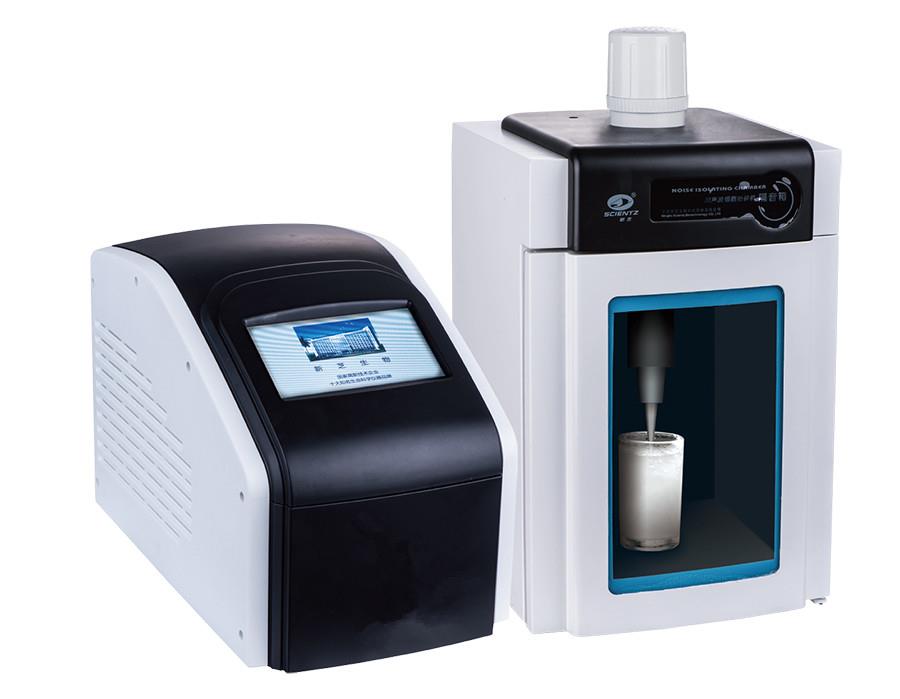 |
Performance characteristics
PWM control power supply, continuous adjustment of working time and power, wider application range;
Displayed with 7-inch TFT high-resolution touch screen;
Centralized control of central microcomputer with higher precision and intelligence;
Sample temperature automatic detection display function, power display microcomputer tracking, fault automatic alarm;
The sound insulation device is made of sheet metal, sprayed plastic, ABS material, moulded design, with door lock function.
Application field
Life science: lysis and fragmentation of cells, viruses, and spores;
Materials Science: Dispersion and cleavage of nanomaterials;
Environmental protection: homogenization, dispersion and extraction of soil rock samples.