

Can a homogenizer be used for pigment dispersion?
Dec 09, 2025
Leave a message
Hey there! As a supplier of homogenizers, I often get asked this question: Can a homogenizer be used for pigment dispersion? Well, let's dive right into it and find out.
First off, what is pigment dispersion? Pigment dispersion is the process of breaking down pigment agglomerates into individual particles and evenly distributing them in a liquid medium. This is crucial in many industries, like paints, inks, coatings, and plastics. High - quality pigment dispersion can enhance the color strength, gloss, and stability of the final product.
Now, let's talk about homogenizers. Homogenizers are machines that use various forces, such as mechanical, ultrasonic, or high - pressure, to break down particles and create a uniform mixture. There are different types of homogenizers, each with its own unique way of working.
Ultrasonic Homogenizers
Ultrasonic homogenizers are one of the popular choices for pigment dispersion. They work by generating high - frequency sound waves in a liquid. These sound waves create alternating high - and low - pressure cycles, which lead to the formation and collapse of tiny bubbles in the liquid, a phenomenon known as cavitation.
When these bubbles collapse, they produce intense local forces, like shockwaves and high - speed microjets. These forces are powerful enough to break apart pigment agglomerates into smaller particles. The advantage of using an ultrasonic homogenizer for pigment dispersion is that it can achieve a high degree of dispersion in a relatively short time.
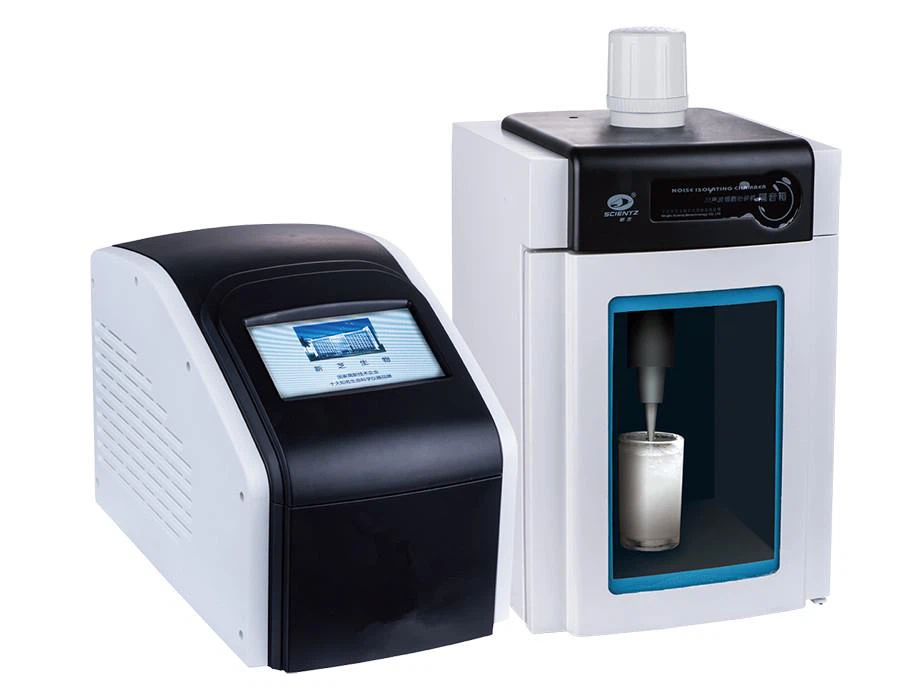
For example, our Scientz08 - II None Touch Small Volume Ultrasonic Homogenizer Equipment Cell Disruptor is great for small - scale pigment dispersion experiments. It's easy to operate and can handle small volumes of samples precisely. If you're looking for something on a larger scale, our Ultrasonic Separator Homogenizer is a solid option. It can separate and homogenize pigments effectively, ensuring a uniform dispersion in larger batches.
High - Pressure Homogenizers
High - pressure homogenizers work by forcing a liquid containing pigments through a small orifice at very high pressure. As the liquid passes through the orifice, the sudden change in pressure and the high - velocity flow cause the pigment agglomerates to break apart.
The high - pressure environment can generate shear forces, which are effective in breaking down the strong bonds between pigment particles. This type of homogenizer is often used in industrial settings where large - scale pigment dispersion is required. Our High Efficient Ultrasonic Homogenizer Ultrasonic Extractor combines the power of high - pressure and ultrasonic technology, offering an efficient solution for pigment dispersion. It can handle a wide range of pigment types and concentrations, making it a versatile choice for different industries.
Benefits of Using Homogenizers for Pigment Dispersion
- Improved Quality: Homogenizers can break down pigment agglomerates into smaller, more uniform particles. This leads to better color development, higher gloss, and improved stability in the final product. For example, in the paint industry, a well - dispersed pigment can result in a smoother finish and better coverage.
- Consistency: With a homogenizer, you can achieve a consistent level of pigment dispersion in every batch. This is important for maintaining product quality and meeting customer expectations. Whether you're producing a small batch of specialty inks or a large volume of industrial coatings, the homogenizer ensures that the pigment is evenly distributed throughout the liquid.
- Time - Saving: Compared to traditional methods of pigment dispersion, like mechanical stirring, homogenizers can disperse pigments much faster. This means you can increase your production efficiency and reduce the overall processing time.
Considerations When Using Homogenizers for Pigment Dispersion
- Pigment Type: Different pigments have different physical and chemical properties. Some pigments may be more difficult to disperse than others. For example, organic pigments often have a more complex structure and may require more intense homogenization conditions compared to inorganic pigments.
- Liquid Medium: The properties of the liquid medium, such as its viscosity and pH, can also affect the pigment dispersion process. A high - viscosity liquid may require more energy to break down the pigment agglomerates, while an inappropriate pH can cause the pigments to flocculate or precipitate.
- Homogenization Parameters: Factors like pressure, temperature, and processing time need to be carefully adjusted according to the specific requirements of the pigment and the liquid medium. For instance, too high a pressure or too long a processing time may damage the pigment particles or cause unwanted chemical reactions.
In conclusion, yes, a homogenizer can definitely be used for pigment dispersion. Whether you choose an ultrasonic homogenizer or a high - pressure homogenizer depends on your specific needs, such as the scale of production, the type of pigment, and the desired level of dispersion.

If you're in the market for a homogenizer for pigment dispersion, we're here to help. Our range of homogenizers offers different features and capabilities to suit various applications. We can provide you with detailed technical support and guidance to ensure you choose the right equipment for your needs. So, if you're interested in learning more or making a purchase, don't hesitate to reach out for a procurement discussion. We're looking forward to working with you!
References
- McClements, D. J. (2015). Food Emulsions: Principles, Practice, and Techniques. CRC Press.
- Walstra, P., Wouters, J. T. M., & Geurts, T. J. (2006). Dairy Technology: Principles of Milk Properties and Processes. CRC Press.