

What is the effect of critical speed on ball mill operation?
Nov 20, 2025
Leave a message
Hey there! As a ball mill supplier, I've seen firsthand how critical speed can have a huge impact on ball mill operation. So, let's dive into what critical speed is and how it affects the way these machines work.
First off, what exactly is critical speed? In simple terms, the critical speed of a ball mill is the speed at which the balls inside the mill start to centrifuge against the wall of the mill. When the mill rotates at or above this critical speed, the balls are held against the inner wall by centrifugal force and don't fall back down to do their grinding job. It's like when you spin a bucket of water really fast in a vertical circle - if you spin it fast enough, the water stays in the bucket instead of spilling out.
Now, why does this matter for ball mill operation? Well, the efficiency of a ball mill depends on the proper movement of the grinding media (the balls). When the mill is operating below the critical speed, the balls cascade and tumble within the mill, effectively grinding the material. This cascading action creates a lot of impact and abrasion, which is great for reducing the size of the particles in the material being processed.
Let's talk about the effects of operating a ball mill at different speeds relative to the critical speed.
Operating Below Critical Speed
When the ball mill runs at a speed significantly below the critical speed, the grinding action is mainly due to the cascading of the balls. The balls roll and slide over each other and the material, breaking it down through a combination of impact and friction. This is the ideal scenario for most grinding applications because it provides a more controlled and efficient grinding process. The material is gradually reduced in size, and the quality of the final product is usually better.
However, if the speed is too low, the grinding process can become very slow. The balls might not have enough energy to break down the larger particles effectively, and the overall throughput of the mill will be reduced. This means you'll need to run the mill for longer periods to achieve the desired particle size, which can increase energy consumption and operating costs.
Operating Near Critical Speed
As the mill speed approaches the critical speed, the behavior of the balls changes. Some of the balls start to move in a more circular path along the inner wall of the mill, and the cascading action becomes less pronounced. This can lead to a decrease in the grinding efficiency because there is less impact and abrasion between the balls and the material.
At speeds very close to the critical speed, the mill might experience what's called "centrifuging." In this state, a large portion of the balls are held against the wall, and the grinding action almost stops. The material isn't being effectively processed, and the mill is just wasting energy.
Operating Above Critical Speed
Running a ball mill above the critical speed is generally a no - go. As I mentioned earlier, when the speed exceeds the critical speed, the balls are completely centrifuged against the wall. There is no cascading or tumbling, so there is no effective grinding taking place. The mill is essentially just spinning without doing any useful work, and it can also cause excessive wear on the mill lining and the balls themselves.
So, how do you determine the right speed for your ball mill? Well, there are some formulas to calculate the critical speed. The most common one is based on the diameter of the mill. The formula is (N_c=\frac{42.3}{\sqrt{D}}), where (N_c) is the critical speed in revolutions per minute (RPM) and (D) is the inside diameter of the mill in meters.
But in real - world applications, you don't want to run the mill at the critical speed. A good rule of thumb is to operate the mill at about 65 - 80% of the critical speed. This allows for a good balance between grinding efficiency and energy consumption.
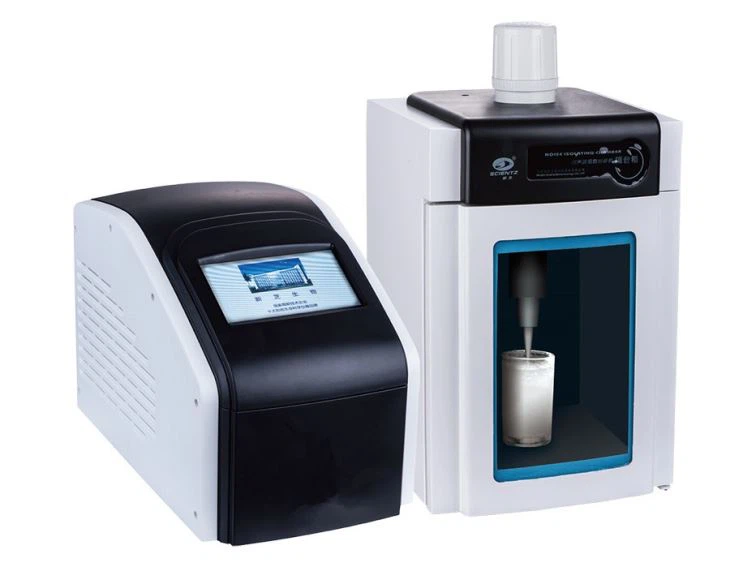
Now, let's talk about some related products that might be of interest to you. If you're in the market for other types of equipment for material processing, you might want to check out our Lab Ultrasonic Transducer Homogenizer. It's a great tool for homogenizing small samples in a laboratory setting.
Another option is the Scientz98 - III Cup - Form Homogenizer. This homogenizer is designed for more specialized applications and can provide precise control over the homogenization process.
And if you're looking to buy a laboratory ultrasonic cell homogenizer, you can visit Buy Laboratory Ultrasonic Cell Homogenizer.

As a ball mill supplier, I know that choosing the right equipment and operating it at the right speed is crucial for your business. If you're having trouble determining the best speed for your ball mill or if you're looking for a new ball mill that can be optimized for your specific application, don't hesitate to reach out. We can help you select the right mill and provide you with all the information you need to operate it efficiently. Whether you're in the mining, chemical, or pharmaceutical industry, we have the expertise to meet your needs.
In conclusion, critical speed plays a vital role in ball mill operation. By understanding how it affects the grinding process, you can optimize the performance of your ball mill, reduce energy consumption, and improve the quality of your final product. So, take the time to calculate the critical speed of your mill and adjust the operating speed accordingly.
If you're interested in purchasing a ball mill or have any questions about our products, feel free to get in touch. We're here to help you make the most of your material processing operations.
References
- "Ball Milling Theory and Practice for the Amateur Pyrotechnician" by Lloyd S. Kenyon.
- "Mineral Processing Design and Operations" by A. B. Mular, D. N. Halbe, and D. J. Barratt.