

How to determine the load capacity of a ball mill?
Jan 15, 2026
Leave a message
Hey there! As a ball mill supplier, I often get asked about how to determine the load capacity of a ball mill. It's a crucial question because getting the load capacity right can significantly impact the efficiency and performance of the ball mill. In this blog, I'll share some insights on how you can figure out the appropriate load capacity for your ball mill.
Understanding the Basics of Ball Mill Load Capacity
First things first, what exactly do we mean by the load capacity of a ball mill? Simply put, it's the amount of material that the ball mill can handle effectively. This includes the grinding media (like balls), the material to be ground, and any additional substances such as water or chemicals if you're using a wet grinding process.
The load capacity is not just about stuffing as much material as possible into the mill. If you overload the ball mill, it can lead to all sorts of problems. The mill might not grind the material properly, resulting in uneven particle sizes. It can also put extra stress on the motor and other components, leading to increased wear and tear and potentially costly breakdowns. On the other hand, if you under - load the mill, you're not making the most of its capabilities, and you'll end up with lower productivity.
Factors Affecting Ball Mill Load Capacity
1. Mill Size and Design
The physical dimensions of the ball mill play a huge role in determining its load capacity. Larger mills generally have a higher load capacity. For example, a big industrial - scale ball mill with a large diameter and length can hold more grinding media and material compared to a small laboratory - sized ball mill.
The design of the mill also matters. Some ball mills are designed with special features like internal liners that can affect the available space for the load. A well - designed mill will have an optimal shape and structure to ensure efficient grinding at different load levels.
2. Grinding Media
The type, size, and quantity of grinding media are important factors. Different types of grinding media, such as steel balls, ceramic balls, or tungsten carbide balls, have different densities and hardness. Steel balls are heavier and more durable, but they might be too aggressive for some delicate materials.
The size of the grinding media also affects the load capacity. Smaller balls can provide more surface area for grinding but might require more of them to fill the mill effectively. You need to find the right balance between the size and quantity of the grinding media to achieve the best grinding results.
3. Material Properties
The characteristics of the material you're grinding are crucial. The hardness, density, and moisture content of the material can all impact the load capacity. Harder materials might require more energy to grind, so you might need to adjust the load accordingly. Materials with high moisture content can be more difficult to grind and might also affect the flow of the material inside the mill.
Methods to Determine Ball Mill Load Capacity
1. Theoretical Calculation
One way to estimate the load capacity is through theoretical calculations. You can start by calculating the volume of the mill's interior. The volume of a cylindrical ball mill can be calculated using the formula (V=\pi r^{2}h), where (r) is the radius of the mill and (h) is its length.
However, you can't fill the entire volume with material and grinding media. A common rule of thumb is to fill the mill to about 30 - 50% of its total volume. This allows enough space for the grinding media to move freely and perform the grinding action.
Let's say you have a ball mill with a radius of 1 meter and a length of 2 meters. The volume (V=\pi\times(1)^{2}\times2 = 2\pi\approx 6.28) cubic meters. If you follow the 30 - 50% rule, the load capacity would be between (6.28\times0.3 = 1.884) cubic meters and (6.28\times0.5 = 3.14) cubic meters.
2. Experimental Testing
Another reliable method is experimental testing. Start by running the ball mill with a small load and gradually increase it while monitoring the performance. You can measure parameters such as the power consumption of the motor, the particle size distribution of the ground material, and the noise level of the mill.
If the power consumption starts to increase significantly or the particle size distribution becomes too wide, it might be a sign that you're approaching the maximum load capacity. Keep in mind that the optimal load capacity might vary depending on the specific material you're grinding and the desired particle size.

Importance of Proper Load Capacity
Getting the load capacity right has several benefits. Firstly, it improves the grinding efficiency. When the mill is loaded correctly, the grinding media can interact with the material in the most effective way, resulting in a more uniform particle size distribution.
Secondly, it reduces energy consumption. An over - loaded mill requires more power to operate, which means higher electricity bills. By operating the mill at its optimal load capacity, you can save on energy costs in the long run.
Finally, it extends the lifespan of the ball mill. A well - loaded mill experiences less stress on its components, reducing the risk of mechanical failures and breakdowns. This means less downtime for maintenance and repairs, which is great for your overall productivity.
Related Products
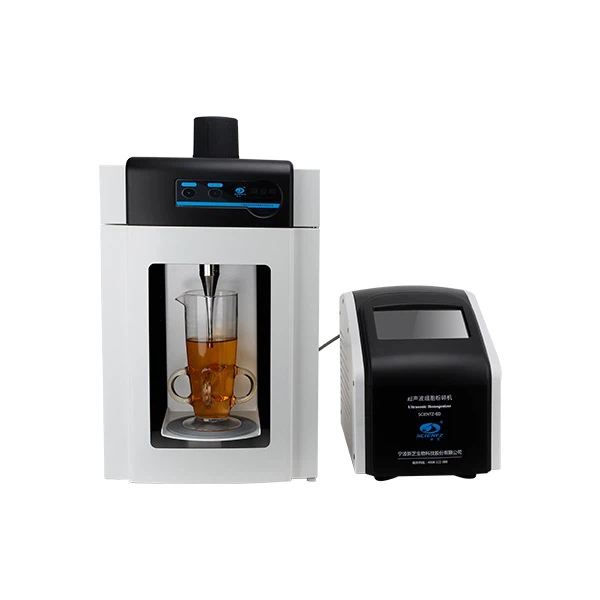
If you're interested in other grinding and homogenizing equipment, we also offer some great products. Check out our Scientz - IID New Type Of Ultrasonic Homogenizer With 7 TFT Touch Display. It's a state - of - the - art device that can be used for a variety of applications. We also have the Probe Sonicator for Cell Lysis and the Lab Homogenizer for more specific laboratory needs.
Let's Connect!
If you're in the market for a ball mill or have any questions about determining the load capacity, don't hesitate to reach out. We're here to help you make the right choice for your specific needs. Whether you're a small - scale laboratory or a large industrial operation, we have the expertise and products to meet your requirements.
References
- "Ball Milling Theory and Practice for the Amateur Pyrotechnician" by Lloyd S. Lamb
- "Mineral Processing Design and Operations: An Introduction" by Barry A. Wills and Tim Napier - Munn