

What is the principle of a sonicator?
Jun 26, 2026
Leave a message
Sonicators are powerful tools widely used in various scientific and industrial fields. As a supplier of high - quality sonicators, I'm excited to share with you the principle behind these remarkable devices.
The Basics of Sonication
Sonication is a process that utilizes ultrasonic waves to create physical and chemical changes in a sample. Ultrasonic waves are sound waves with frequencies higher than the upper limit of human hearing, typically above 20 kHz. When these waves are introduced into a liquid medium, they generate a series of effects that can be harnessed for different applications.
Cavitation: The Key Mechanism
The fundamental principle of sonication is based on a phenomenon called cavitation. Cavitation occurs when the ultrasonic waves create alternating high - and low - pressure cycles in the liquid. During the low - pressure phase, tiny bubbles, known as cavitation bubbles, are formed in the liquid. These bubbles grow as they absorb energy from the ultrasonic field.
When the pressure cycle changes to the high - pressure phase, the cavitation bubbles collapse suddenly. This implosion is extremely violent and generates intense local conditions. Temperatures can reach up to several thousand Kelvin, and pressures can be as high as hundreds of atmospheres. These extreme conditions are the driving force behind many of the effects achieved through sonication.
Physical Effects of Sonication
Homogenization
One of the most common applications of sonicators is homogenization. Homogenization is the process of making a mixture uniform in composition. In a biological or chemical sample, particles or droplets may be unevenly distributed. When a sonicator is used, the high - energy cavitation events break down larger particles into smaller ones.
For example, in the food industry, sonicators can be used to homogenize milk. The cavitation bubbles break down the fat globules in milk, preventing them from separating and creating a more stable and uniform product. In a laboratory setting, sonicators are often used to homogenize cell suspensions. The violent collapse of cavitation bubbles disrupts cell membranes, releasing intracellular contents and creating a homogeneous mixture of cellular components.
If you are looking for a high - performance homogenizer, our Big Volume Power Adjustable Nano Sonics Ultrasonic Homogenizer is an excellent choice. It offers precise power adjustment and can handle large volumes of samples, making it suitable for both research and industrial applications.
Emulsification
Emulsification is another important physical effect of sonication. An emulsion is a mixture of two immiscible liquids, such as oil and water. When a sonicator is applied to an oil - water mixture, the cavitation bubbles create shear forces that break the oil droplets into smaller sizes and disperse them evenly in the water phase.
This process is widely used in the cosmetic and pharmaceutical industries. For instance, in the production of creams and lotions, sonicators can be used to create stable emulsions of oil and water - based ingredients. The small droplet size achieved through sonication improves the texture and stability of the final product.
Chemical Effects of Sonication
Extraction
Sonication is also a powerful tool for chemical extraction. In many cases, valuable compounds are trapped within solid matrices, such as plant tissues or minerals. The high - energy cavitation events generated by sonicators can break the cell walls or solid structures, releasing the target compounds into the surrounding solvent.
In the field of traditional Chinese medicine, sonication is used for the extraction of active ingredients from Chinese herbal medicines. Our Chinese Herbal Medicine Power Adjustable LCD Display Ultrasonic Extraction device is specifically designed for this purpose. It allows for precise control of power and time, ensuring efficient extraction of the desired compounds.
The cavitation bubbles also enhance the mass transfer between the solid and the solvent. The violent collapse of the bubbles creates micro - jets and turbulence, which increase the contact area between the solid matrix and the solvent, facilitating the dissolution of the target compounds.
Chemical Reactions
Sonication can also accelerate chemical reactions. The extreme conditions generated during cavitation, such as high temperatures and pressures, can provide the activation energy required for chemical reactions to occur. Additionally, the micro - jets and turbulence created by cavitation can enhance the mixing of reactants, increasing the frequency of collisions between molecules and thus speeding up the reaction rate.
For example, in organic synthesis, sonicators can be used to promote reactions that are otherwise slow or require harsh reaction conditions. The sonication - assisted reactions often result in higher yields and shorter reaction times.
Separation
Sonication can be used for separation processes as well. In an ultrasonic extraction separator, the ultrasonic waves can be used to separate different components of a mixture based on their physical properties.
Our Ultrasonic Extraction Separator takes advantage of the cavitation effects to separate particles or substances from a liquid medium. For example, in a suspension, the cavitation bubbles can cause the particles to aggregate or sediment, making it easier to separate them from the liquid.
Factors Affecting Sonication
Several factors can affect the efficiency of sonication. The frequency of the ultrasonic waves is an important parameter. Different frequencies are suitable for different applications. Lower frequencies (e.g., 20 - 40 kHz) are generally more effective for generating cavitation and are often used for homogenization and extraction. Higher frequencies (e.g., above 100 kHz) are better for applications where a more gentle treatment is required, such as cleaning.
The power of the sonicator also plays a crucial role. Higher power levels generally result in more intense cavitation and faster processing times. However, excessive power can cause overheating and damage to the sample. Therefore, it is important to choose the appropriate power level based on the nature of the sample and the desired effect.
The duration of sonication is another factor to consider. Longer sonication times can lead to more complete processing, but they also increase the risk of sample degradation. It is necessary to optimize the sonication time to achieve the best results.
Conclusion
In conclusion, the principle of a sonicator is based on the phenomenon of cavitation, which generates extreme physical and chemical conditions in a liquid medium. These conditions can be harnessed for a wide range of applications, including homogenization, emulsification, extraction, chemical reactions, and separation.

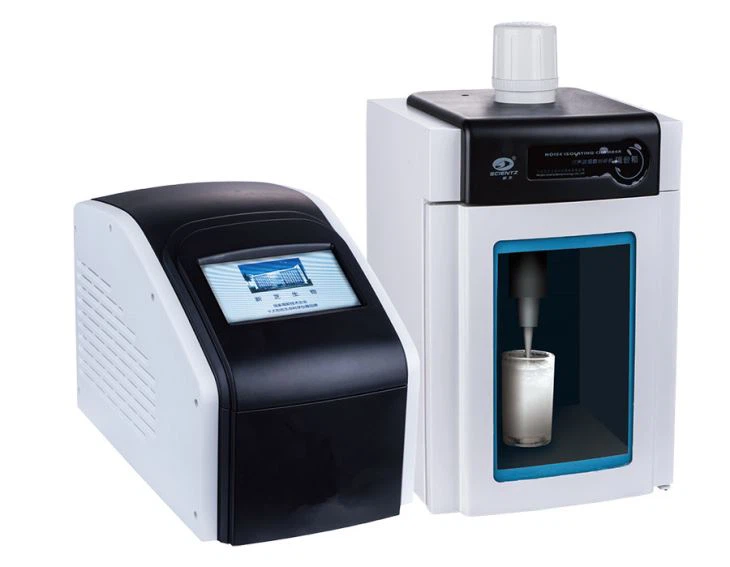
As a leading supplier of sonicators, we offer a variety of high - quality products to meet the diverse needs of our customers. Whether you are in a research laboratory, a manufacturing plant, or a traditional medicine production facility, our sonicators can provide you with reliable and efficient solutions.
If you are interested in our products or have any questions about sonication technology, we encourage you to contact us for a detailed discussion and to explore the possibilities of procurement. Our team of experts is ready to assist you in finding the most suitable sonicator for your specific requirements.
References
- Mason, T. J. (1990). Sonochemistry: The chemical effects of ultrasound. Elsevier.
- Suslick, K. S. (1988). Sonochemistry. Science, 247(4947), 1439 - 1445.
- Price, G. J. (2007). Applications of power ultrasound in food processing. Ultrasonics Sonochemistry, 14(3), 381 - 392.