

What is the noise level of a vacuum dryer?
Jan 27, 2026
Leave a message
What is the noise level of a vacuum dryer?
As a supplier of vacuum dryers, I often receive inquiries from customers about various aspects of our products, and one question that comes up quite frequently is about the noise level of vacuum dryers. Understanding the noise level is crucial for customers, especially those who plan to use the equipment in environments where noise can be a concern, such as laboratories, research facilities, or even some industrial settings.
Factors Affecting the Noise Level of Vacuum Dryers
The noise level of a vacuum dryer is influenced by several factors. First and foremost is the type of vacuum pump used. Different vacuum pumps have distinct noise characteristics. For example, rotary vane pumps, which are commonly used in many vacuum dryers, can produce a relatively constant humming sound. The noise is mainly generated by the mechanical movement of the vanes inside the pump chamber as they create and maintain the vacuum. The speed of the pump also plays a role; higher - speed pumps tend to be noisier.
Another factor is the design and construction of the dryer itself. A well - engineered vacuum dryer with proper insulation can significantly reduce the noise transmitted to the surrounding environment. The materials used in the cabinet, such as thick - walled steel or high - density plastics, can act as sound barriers. Additionally, the internal layout of the components can affect noise levels. If the components are not properly mounted or if there is excessive vibration, it can lead to increased noise.
The working conditions of the vacuum dryer also impact the noise. When the dryer is operating at full capacity, it may produce more noise compared to when it is running at a lower load. For instance, during the initial stages of the drying process when the vacuum is being established, the pump has to work harder, and this can result in a louder noise.
Measuring the Noise Level
The noise level of a vacuum dryer is typically measured in decibels (dB). A quiet environment, such as a bedroom at night, may have a noise level of around 30 - 40 dB. Normal conversation usually occurs at about 60 dB. When it comes to vacuum dryers, the noise level can vary widely depending on the model and the factors mentioned above.
Some of our entry - level vacuum dryers may have a noise level in the range of 50 - 60 dB. These are often designed with smaller pumps and basic insulation, suitable for less noise - sensitive applications. On the other hand, our high - end models, which are equipped with advanced pumps and better insulation, can operate at noise levels as low as 40 - 50 dB.
For example, our Scientz - 18ND Freeze Drying Machine Freeze Dryers Lyophilizers With Electrical Heating is designed with noise reduction in mind. It uses a high - efficiency vacuum pump that has been optimized for quiet operation. The cabinet of the dryer is made of thick - walled steel with internal insulation, which helps to keep the noise level down to around 50 - 55 dB. This makes it an ideal choice for laboratories where a quiet working environment is essential.
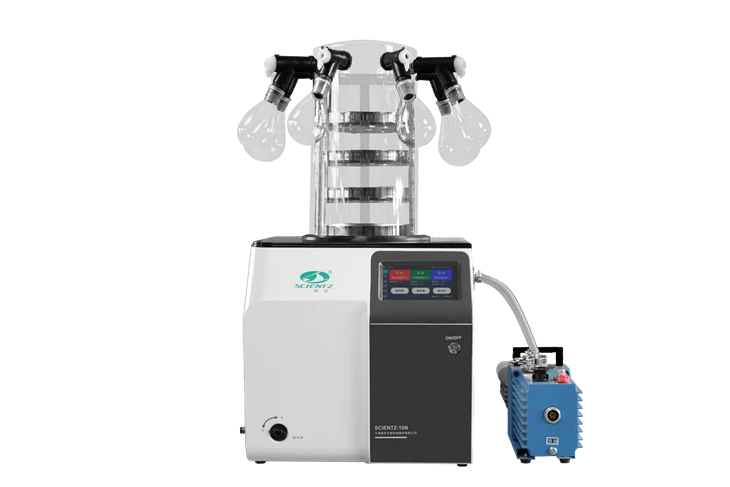
Our SCIENTZ - 10N/C Laboratory Freeze Dryer is another model that offers a relatively low noise level. It has a compact design and is equipped with a pump that has been carefully selected for its quiet operation. The overall noise level of this dryer is typically in the range of 45 - 50 dB, making it suitable for use in smaller laboratories or research areas where noise needs to be minimized.
Importance of Low Noise Levels
Low noise levels in vacuum dryers are not just a matter of comfort; they can also have practical implications. In a laboratory setting, excessive noise can be a distraction for researchers, affecting their concentration and potentially leading to errors in experiments. In industrial settings, high - noise levels can pose a risk to the health of workers. Prolonged exposure to noise levels above 85 dB can cause hearing damage, so keeping the noise level of the vacuum dryer as low as possible is essential for the well - being of employees.
Moreover, in some applications, such as in a cleanroom environment, noise can disrupt the delicate balance of the space. Even a small amount of noise can cause air turbulence, which may affect the quality of the products being dried.
Comparing with Other Equipment
When compared to other types of drying equipment, vacuum dryers generally have a relatively low noise level. For example, some convection dryers use large fans to circulate hot air, and these fans can be quite noisy. The mechanical components in a convection dryer, such as the motor and the fan blades, generate a continuous, high - pitched noise. In contrast, vacuum dryers rely more on the vacuum pump, and with proper design, the noise can be better controlled.
Noise Reduction Technologies
To further reduce the noise level of our vacuum dryers, we are constantly exploring and implementing new technologies. One such technology is the use of variable - speed drives (VSDs) for the vacuum pumps. VSDs allow the pump to adjust its speed according to the actual demand, which not only saves energy but also reduces noise. When the dryer does not require a high - vacuum level, the pump can operate at a lower speed, resulting in less noise.
We also use vibration - damping materials to isolate the components from the cabinet. Rubber mounts and shock absorbers can be used to reduce the vibration transmitted from the pump and other moving parts to the dryer's body, thereby reducing the noise.
Product Recommendations
If you are looking for a vacuum dryer with a low noise level for your laboratory, our Scientz - 18ND Freeze Drying Machine Freeze Dryers Lyophilizers With Electrical Heating is an excellent choice. It offers a combination of high - performance drying and quiet operation. For smaller - scale applications, the SCIENTZ - 10N/C Laboratory Freeze Dryer is a great option.
If you are in the cosmetics industry, our Cosmetics Freeze - drying Machine is designed to meet your specific needs. It not only ensures the high - quality drying of cosmetics but also operates with a relatively low noise level, which is important in a production environment where workers need to communicate and where the quality of the products needs to be maintained.
Contact Us for Purchase and Consultation
If you are interested in learning more about the noise levels of our vacuum dryers or if you are considering purchasing one for your specific application, we encourage you to get in touch with us. Our team of experts can provide you with detailed information about the products, including noise level specifications, performance data, and pricing. We can also assist you in selecting the most suitable vacuum dryer based on your requirements. Whether you are a small - scale laboratory or a large - scale industrial enterprise, we have the right solution for you.

References
- "Handbook of Vacuum Technology", by O. Balzers.
- "Noise Control Engineering: Principles and Applications", by L. L. Beranek.
- Industry research reports on vacuum drying equipment.