

What accessories are available for a lab mixer?
Dec 16, 2025
Leave a message
As a trusted supplier of lab mixers, I understand the importance of having the right accessories to enhance the functionality and efficiency of these essential laboratory tools. In this blog post, I will explore the various accessories available for lab mixers, providing insights into their features, benefits, and applications.

Mixing Blades and Impellers
Mixing blades and impellers are fundamental accessories for lab mixers, as they directly influence the mixing performance. Different types of blades and impellers are designed to handle various mixing tasks, such as blending, homogenizing, and dispersing.
- Propeller Blades: Propeller blades are commonly used for simple mixing tasks in low - viscosity liquids. They are efficient at creating axial flow, which moves the liquid in a straight line up and down the mixing vessel. This type of blade is ideal for quickly blending homogeneous solutions and is often used in applications where gentle mixing is required, such as dissolving salts in water.
- Turbine Impellers: Turbine impellers are suitable for more demanding mixing applications, especially those involving high - viscosity liquids or the need for intense shear forces. They create a radial flow pattern, which helps to break up particles and distribute them evenly throughout the mixture. Turbine impellers are commonly used in processes like Homogenized emulsions and dispersing solids in liquids.
- Paddle Blades: Paddle blades are designed for slow - speed mixing and are often used in applications where gentle agitation is necessary to prevent damage to delicate materials. They are typically used in mixing viscous materials, such as creams and pastes, and can also be used to maintain a uniform temperature distribution in a mixture.
Mixing Vessels
The choice of mixing vessel is crucial for achieving optimal mixing results. Different types of vessels are available, each with its own unique features and advantages.
- Beakers and Flasks: Beakers and flasks are the most common types of mixing vessels in laboratories. They are available in various sizes and materials, such as glass and plastic. Glass vessels are preferred for their transparency, which allows for easy observation of the mixing process, while plastic vessels are lightweight and less prone to breakage.
- Mixing Tanks: Mixing tanks are larger vessels that are used for batch mixing of larger volumes of liquids. They are often equipped with baffles to improve mixing efficiency by preventing the formation of a swirling motion in the liquid. Mixing tanks can be made of stainless steel, glass - lined steel, or other corrosion - resistant materials, depending on the nature of the mixture.
- Reaction Kettles: Reaction kettles are specialized mixing vessels that are designed for chemical reactions. They are typically equipped with heating and cooling jackets to control the temperature of the reaction mixture, as well as agitators to ensure thorough mixing. Reaction kettles are commonly used in pharmaceutical, chemical, and food processing industries.
Speed Controllers
Speed controllers are essential accessories for lab mixers, as they allow users to adjust the mixing speed according to the requirements of the application.
- Manual Speed Controllers: Manual speed controllers are the simplest type of speed controllers. They typically consist of a dial or knob that can be turned to adjust the speed of the mixer. Manual speed controllers are easy to use and are suitable for applications where the mixing speed does not need to be precisely controlled.
- Digital Speed Controllers: Digital speed controllers offer more precise control over the mixing speed. They display the speed in numerical values and often allow users to set a specific speed or a speed range. Digital speed controllers are commonly used in applications where accurate mixing speed is critical, such as in scientific research and quality control.
Temperature Controllers
Temperature control is important in many mixing applications, especially those involving chemical reactions or the handling of heat - sensitive materials.
- Heating Jackets: Heating jackets are used to heat the mixing vessel and its contents. They can be electrically heated or heated by a circulating fluid, such as hot water or steam. Heating jackets are commonly used in applications where the reaction mixture needs to be maintained at a specific temperature.
- Cooling Coils: Cooling coils are used to cool the mixing vessel and its contents. They work by circulating a cooling fluid, such as chilled water, through a coil that is wrapped around the outside of the vessel. Cooling coils are often used in applications where the reaction generates heat and needs to be kept at a low temperature.
Safety Accessories
Safety is of utmost importance in the laboratory, and there are several accessories available to ensure the safe operation of lab mixers.
- Guard Rails: Guard rails are used to prevent accidental contact with the moving parts of the mixer, such as the blades and impellers. They are typically made of metal or plastic and are installed around the mixer to provide a physical barrier.
- Emergency Stop Buttons: Emergency stop buttons are essential safety features that allow users to quickly stop the mixer in case of an emergency. They are usually located within easy reach of the operator and are designed to immediately cut off the power supply to the mixer.
Specialized Accessories
In addition to the above - mentioned accessories, there are also several specialized accessories available for lab mixers, depending on the specific application.
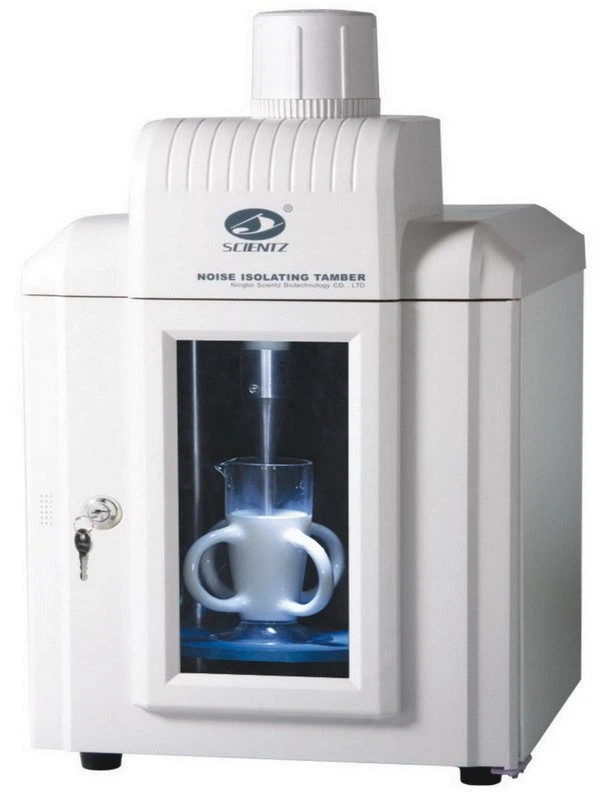
- Automatic, manual two modes Lab Scale Ultrasonic Processor For Extraction Emulsification And Cell Disruption: This type of accessory uses ultrasonic waves to create intense shear forces, which are ideal for processes such as extraction, emulsification, and cell disruption. It can significantly improve the efficiency of these processes compared to traditional mixing methods.
- Ultrasonic Homogenizer For Sample Emulsification, Homogenization, Dispersion: Ultrasonic homogenizers are designed to break down particles and create a uniform mixture. They are commonly used in biological and pharmaceutical research, as well as in the food and beverage industry.
In conclusion, the availability of a wide range of accessories for lab mixers allows users to customize their mixing equipment to meet the specific requirements of their applications. Whether you need to mix low - viscosity liquids, high - viscosity materials, or perform chemical reactions, there is an accessory available to enhance the performance and efficiency of your lab mixer.
If you are interested in learning more about our lab mixers and the accessories we offer, or if you have specific requirements for your laboratory mixing needs, please feel free to contact us for a detailed discussion and procurement negotiation. We are committed to providing high - quality products and excellent customer service to help you achieve the best results in your laboratory work.
References
- Perry, R. H., & Green, D. W. (Eds.). (1997). Perry's Chemical Engineers' Handbook. McGraw - Hill.
- Walas, S. M. (1990). Chemical Process Equipment: Selection and Design. Butterworth - Heinemann.