

How do I optimize a Blender project for performance?
Dec 16, 2025
Leave a message
Optimizing a Blender project for performance is crucial, whether you're a hobbyist animator or a professional in a production studio. As a Blender supplier, I've seen firsthand how much of a difference proper optimization can make. Let's explore some key strategies that can significantly boost the performance of your Blender projects.
1. Geometry Optimization
One of the most fundamental ways to optimize a Blender project is by managing the geometry effectively. High - polygon models can quickly overwhelm your system's resources, leading to slow rendering and a laggy viewport experience.
Start by using edge loops and subdivision surfaces wisely. Subdivision surfaces are great for creating smooth, detailed models, but they should be used sparingly in areas where extreme detail isn't necessary. You can achieve a good balance by using a lower - resolution base mesh and applying subdivisions only where needed. For example, if you're modeling a character, you might use a higher subdivision level on the face but a lower one on the body.
Another technique is to reduce the number of unnecessary polygons. Look for areas where you can simplify the geometry without sacrificing the overall look of the model. Blender offers tools like the Decimate Modifier, which can automatically reduce the polygon count of a mesh while maintaining its shape as closely as possible. By using this modifier smartly, you can often reduce the polygon count by a significant percentage without any noticeable visual degradation.
2. Material and Texture Management
Materials and textures play a huge role in the performance of your Blender project. Complex shaders and high - resolution textures can require a lot of processing power.
Opt for simpler shaders whenever possible. Instead of using elaborate node setups with multiple layers and complex calculations, try to create a shader that achieves a similar effect with fewer nodes. For example, if you're creating a metal material, you might be able to use a basic Principled BSDF shader with some minor adjustments rather than a custom node setup that simulates every aspect of metal reflection and refraction.
When it comes to textures, keep the resolution in check. High - resolution textures can add a great deal of detail, but they also take up a lot of memory. You can resize your textures to the appropriate size for your project. Blender allows you to assign different texture resolutions for different zoom levels, which can be a useful way to manage memory usage. Additionally, consider using compression formats for your textures. Formats like JPEG and PNG with appropriate compression settings can significantly reduce the file size of your textures without a major loss of quality.
3. Lighting Optimization
Lighting is an essential aspect of any Blender project, but it can also be a major performance drain. There are several ways to optimize lighting in your scene.
First, reduce the number of lights. Each light in a scene requires additional calculations, so try to use as few lights as possible to achieve the desired effect. For example, if you have multiple point lights that are creating a similar effect, you might be able to combine them into a single light or use a more efficient light type.
Use light baking where appropriate. Baking lights means pre - calculating the lighting information and storing it in a texture. This can reduce the real - time processing requirements during rendering. Blender has a built - in light baking feature that allows you to create a baked light map for your scene.
Also, be careful with the type of lights you use. Some light types, such as area lights, are more computationally expensive than others. Point lights and spotlights are generally less resource - intensive, so use them when you can.
4. Scene Organization
A well - organized scene can have a positive impact on performance. Group related objects together using Blender's collection system. This not only makes your scene easier to manage but also allows Blender to optimize the way it processes and displays the objects.
Hide or disable objects that aren't currently needed. For example, if you're working on a particular part of a large scene and don't need all the objects to be visible or active, you can hide or disable the others. This can significantly reduce the processing load on your system.
5. Render Settings Optimization
The render settings you choose can have a huge impact on the performance of your Blender project. Adjusting these settings correctly can lead to faster render times without sacrificing too much quality.
Select the appropriate render engine for your project. Blender offers multiple render engines, such as Cycles and Eevee. Cycles is a powerful and realistic renderer, but it can be very slow, especially for complex scenes. Eevee is a real - time renderer that is much faster and is suitable for many projects where you don't need extremely high - end realism.

Adjust the render samples. In Cycles, the number of samples determines the quality and noise level of the render. However, increasing the number of samples significantly increases the render time. You can start with a lower number of samples and gradually increase them until you achieve an acceptable level of quality.
Our Blender Products
As a Blender supplier, we offer a range of high - quality products that can aid in your projects. For example, our LCD Laboratory Ultrasonic Sterile Homogenizer is a great tool for various laboratory applications. It combines the power of ultrasonic technology with a sterile environment, ensuring efficient and reliable performance.
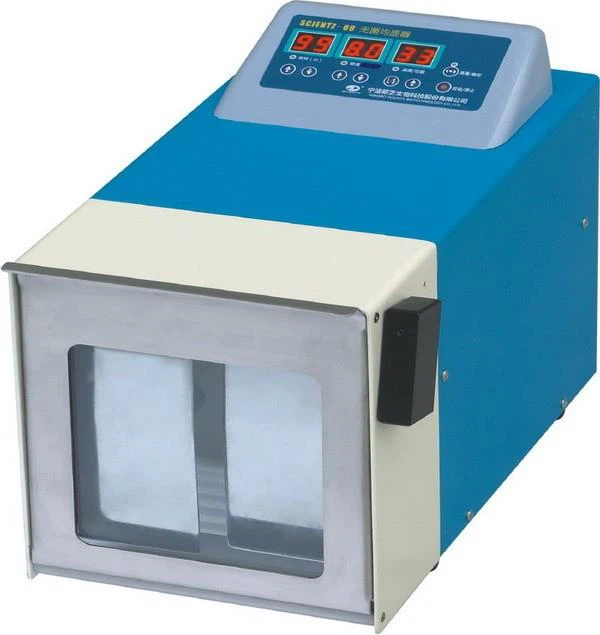
Our Scientz - 09 Digital Display Laboratory Paddle Blenders are another excellent option. These blenders come with a digital display, allowing for precise control of the blending process. They are designed to meet the high - standards of laboratory work.
If you're in the field of microbiology, our Stomacher Blender Microbiology is the ideal choice. It is specifically engineered to handle microbiological samples, providing accurate and repeatable results.
Contact Us for Procurement
If you're interested in optimizing your Blender projects with our high - quality products, we invite you to contact us for a procurement discussion. We have a team of experts who can provide you with detailed information and guidance to help you choose the right products for your specific needs.
References
- Blender Foundation. (Year). Blender Documentation. [Publisher location: City, State].
- Smith, J. (Year). 3D Modeling and Animation with Blender. [Book Publisher].